
a small bakery in Rome

It’s Tuesday and the alarm clock is set to 5 a.m. It’s a steaming-hot summer day close to Via Vittoria, and I slip into something linen before I bike my way to work. I started the bakery three years ago with a packed duffle bag and three words of Italian in my vocabulary. I didn’t know how to bake, but I loved a croissant like I’d had my hands stuffed in dough from birth.
My regulars, Maria and Lauro, come every morning at 6 a.m. sharp. They own a fish shop down by Via Elena. They met in a small town outside of Florence, San Geminiano, when they were twelve and naturally knew they were destined for each other. Their son is set up to manage the shop once he turns eighteen, but he keeps selling overpriced cigarettes and gum outside the pantheon to tourists that will fall for it. I thought they would be worried, but they say it will pass. The sun is up and bright in July, so I keep the doors open for the breeze to creep in while the coffee overheats the waiting area. They discuss politics, music, family, fish prices. I overhear and dot down words I might use later in conversations.
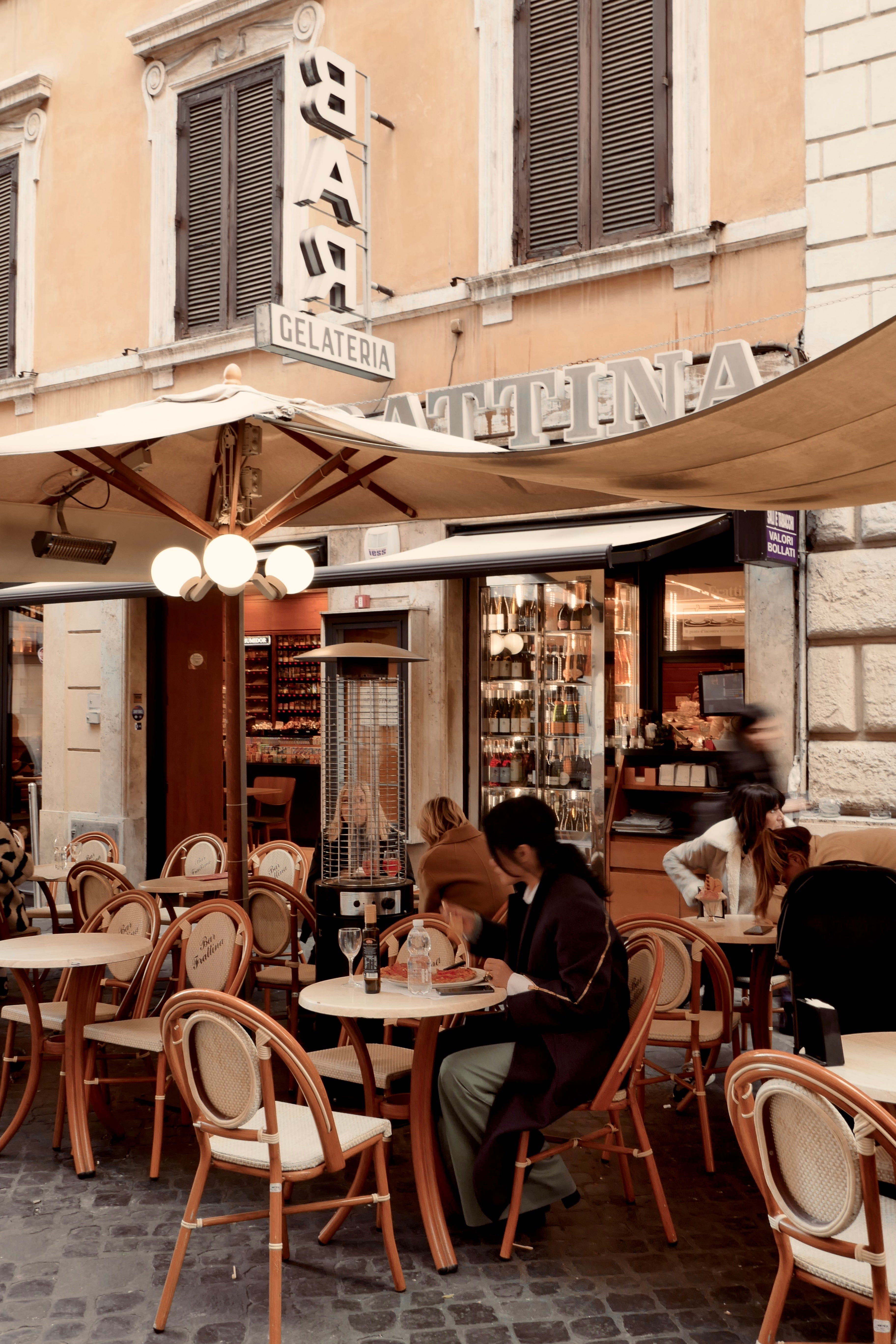
Two espressos, one cornetto, and a panino to go. Packed and heated. Three euros.
“Take the change,” Lauro says.
Perfect example of an Italian man. White button-down shirt with jeans that look like they belong in an 80’s showroom. Brutally honest but kind. No sugar or milk but will take you up on a good panettone as soon as November rolls in. My lousy “Grazie” sounds like I pulled it out of a language course book on eBay— one of those that they give you on a guided tour around the colosseum where they make you listen to a recording of some woman from Iowa explaining why it hasn’t been renovated. The coins flicker in the tip jar and for a second I’m alone. I hear the bells ring and the slight brush of a broom being swiped against the cobblestones. I’m happy. My cup of coffee is steaming hot and the newspaper is my reading assignment for the day. I make enough money to get gelato and pay my rent. I have friends that teach me how to cook and how to drink on weekdays without feeling guilty. I run across the city for sport. I take a work break from 1-3 pm. I go dancing often. It feels like exhaling. It’s good. It’s simple.
the dream I built
That bakery is not real. At least not in the tangible world. I’ve never stood behind that counter, never folded dough at dawn, never swept those cobblestones or seen Lauro’s jeans. But I’ve lived there more times than I’ve lived in most of my own memories this winter. I built it without meaning to: a tiny sanctuary stitched together from the corners of every café I ever loved during my visits to Madrid, Paris, Rome. Assembled from the words I overheard from locals as they sipped on cheap wine on Wednesdays and took the long, scenic way home. I visit it subconsciously on the days when I start treating my life like a puzzle with missing pieces. When I start questioning how much more I could be doing, or how much weight I could be losing, or how much more I could prove. How far I could push myself if I stopped asking what I actually want and focused only on what I can produce.
In Ancient Greece, Epicurus believed that nothing is enough for the person who always wants more. He believed that happiness was woven from simple pleasures: good bread, time out in the sun, loyal company, the kind of quiet that comes from not needing to grip everything so tightly. From letting go. He wasn’t warning against ambition or passion or drive: he was warning against hunger without reason or purpose. Wanting so much more from life, people, love, yourself — that you lose track of the things that were once enough for you. The things that made you feel full, whole, and quietly happy before you convinced yourself you needed to become more to deserve them.
“If you wish to make Pythocles wealthy, do not give him more money; rather, reduce his desires.”
— Epicurus
Epicurus taught Pythocles that if he wished to be wealthy (his eager, brilliant, easily stirred young student), he shouldn’t be given more, but rather taught to desire less. I think about that often, because in so many ways I am Pythocles: always refining, always imagining a better, sharper, more extraordinary version of myself waiting just beyond the next accomplishment. In that bakery in Rome, I become Metrodorus: the one that believed happiness was not a pursuit but a way of life. A practice of standing inside your own self, quietly, without constantly needing more. He thought joy lived in the uncomplicated corners of the day: in the tenderness of routine, the steadiness of friendship, the ability to find peace in the overlooked, ordinary moments that provided what was necessary. The woman in the bakery is wealthy in the most ancient sense: a cup of coffee trembling with heat in her hands, the rugged book with scribbled Italian words she’s learned from customers, friends that love her, a good gelato that’s worth every cent. Nothing extravagant. Nothing earned. Just enough.
It’s in that simplicity that Epicurus’s wisdom becomes visible. The bakery reduces my desires until I can see the outline of a life that already holds everything essential: one consistently trying to teach me the quiet practice of needing less and the simultaneous feeling of profound fullness. Everything that is small and unremarkable in that dream also holds enormous value: Maria’s stories about her son, the linen shirt that lets the summer heat feel light, the bells overheard every day at the same time. Through the nostalgia I feel for a bakery I do not own, I recognize something I hope to never lose in my real life:
I am grateful—truly—for everything I have. The opportunities that would have made my younger self scream at the top of her lungs. The people who genuinely love me. The work I get to do. The dreams I am in the middle of living: ones I prayed for over years, with the kind of hope that felt like it traveled through every inch of my skin. But I hope I never lose sight of that gratitude because of momentum or let simple yet profoundly important moments start to feel like distractions simply because I didn’t stop long enough to see their significant worth. A shared afternoon with my grandfather, a slow walk with my mother through the grocery store, the way my boyfriend’s voice drifts when he’s half-asleep on the phone. The fleeting things that emulate the gifts Epicurus talked about. The real wealth we are meant to hold on to.
The bakery, in all its physical inexistence, teaches me more than many of the hand-picked self-help books stacked in the corner of my room. It lets me recognize that nothing truly belongs to me. That it was never meant to be a real place at all. It was a oasis for the adoration of the minimal—for the gentle and the ordinary—and somehow, in the recognition of that smallness, I become the richest I have ever been.
andre :)
Loveeeee! Makes me miss home 🥲🥰